Blow Dryer With Spinning Brush: Rotating vs. Standard
Quick Answer: A blow dryer with a spinning brush has a barrel that rotates under motor power, so the hair wraps itself instead of you turning your wrist. Most popular one-step brushes do not actually spin. Rotating models trade airflow for motion — typically 500 watts against 1,100 — which makes them slower to dry but easier to control.
The most common misunderstanding in this category is a naming problem. Shoppers search for a “blow dryer with spinning brush,” land on the best-selling one-step brushes, and buy a tool whose barrel does not rotate at all. The two products look nearly identical on a listing page and work differently in the hand.
This is the comparison version: what rotation actually does, what it costs, and how the brands people search for by name actually differ. Some of them do not make the product the search implies. Product categories fill with these mismatches whenever a term becomes generic — the same pattern shows up in how buyers shop for dental veneers, where the words in the ad and the thing in the box diverge.
Rotating vs. Standard: What Spinning Actually Changes
A rotating brush drives the barrel with a small motor, in one or both directions, while air blows through it. A standard one-step brush heats and blows but leaves all motion to your wrist.
What rotation buys you is arm position. The hardest part of a home blowout is turning a brush behind your own head while keeping tension — rotation does that turn for you, which is a genuine accessibility gain for anyone with limited shoulder mobility or a lot of hair to get through.
What it costs is airflow and power. A rotating barrel needs a drive motor in a handle that is already crowded, so wattage goes to rotation instead of heat and air. The Conair InfinitiPRO Spin Air, the most widely sold rotating styler in the US, runs 500 watts with two heat settings plus cool, bidirectional spin, and interchangeable 2-inch and 1.5-inch heads. Non-rotating brushes from Revlon, Remington and MINT commonly run 1,100 watts. That gap is over half the power, and it shows up as drying time.
The second cost is snagging. A powered barrel keeps turning whether or not the hair is feeding smoothly onto it, so a tangle that a static brush would stall against gets pulled instead. Better rotating models mitigate this with flexible bristles and a spin-off mode; none eliminate it.
Neither design is superior in the abstract. Rotation is a control aid that costs power. If you want the underlying mechanics first, the explainer on what a blow dryer brush is and how it is built covers the four components every model in this comparison shares.
Listing language is doing a lot of work in this category, and it is worth reading with the same skepticism you would apply to any packaging claim — the box shapes perception well before the product does.
Mane Blow Dryer Brush
Mane, the tool line from celebrity hairstylist Jen Atkin, does not make a blow dryer brush in the hot-air sense. Its heated product — the round brush that drove the brand’s growth after launching in 2024 — is a heated round brush: the barrel warms up, but no air moves through it, and it is used on hair that is already dry.
That puts it in a different category than everything else here. It behaves closer to a curling iron shaped like a brush, running at a preset temperature of 355°F (380°F on the jumbo size) across four barrel sizes, with no heat dial to set. The fixed temperature is a deliberate safety decision and a real limitation depending on your hair.
Mane also sells passive round brushes, including a 33mm ceramic barrel intended to be paired with a separate dryer. Neither product rotates, and neither dries hair. If you searched for a Mane blow dryer brush expecting a one-step tool, the brand does not currently make one.
Remington Blow Dryer Brush
Remington makes several one-step brushes, none of which rotate, and the line is the value entry in this comparison. Two models come up most:
- Shine Therapy Hair Dryer Brush — 2.4-inch oval barrel, 1,100 watts, two heat and speed settings plus a cool shot, with a ceramic barrel the company describes as keratin and argan-oil infused.
- Pro Wet2Style Oval Dryer & Volumizing Brush — a vented barrel coated in ceramic and titanium, with separate heat and speed controls and a cool shot, marketed for use on wetter hair than the category norm.
Remington’s positioning is straightforward: the specifications are competitive with tools costing considerably more, and the build quality and warranty terms are where the price difference lives. For an occasional user, that is often the right trade.
Paul Mitchell Blow Dryer Brush
Paul Mitchell does not make a blow dryer brush either, and this is the most consistently mis-sold search in the category. The product people find under that name is the Express Ion Round — a passive vented aluminum round brush with corkscrew-shaped vegan bristles. It has no motor, no heating element, and no cord.
The design intent is real, though. A vented aluminum barrel heats up from the dryer’s own airflow and holds that heat against the section, which is a legitimate way to speed a blowout — it is simply the two-tool method, executed with good tools. Paul Mitchell’s matching dryers are the Express Ion Dry+ at 1,875 watts and the Express Ion at 1,500 watts with a digital brushless motor.
So the fair reading: Paul Mitchell competes in this space with a professional-grade two-piece system rather than a one-step tool. If you want the salon method, it is a strong option. If you want one tool in one hand, it is not the brand.
National Hair Dryer With Brush
National is a defunct brand name, and searches for a “National hair dryer with brush” are almost always landing on legacy stock or grey-market imports. National was Matsushita Electric’s appliance brand — the company now known as Panasonic — and it was retired in Europe around 1980, in Australia and New Zealand in 1988, and finally in Japan on October 1, 2008.
The successor products are sold as Panasonic, including the hot air brush line still popular in Japan. Two cautions apply if you are buying one:
- Voltage. Japanese domestic appliances run on 100 volts. Plugged into a North American 120-volt outlet they will typically run hot; into a 220-volt European outlet through a plug adapter they will fail immediately.
- Support. A discontinued brand means no warranty path and no parts, on a heated appliance.
Anything currently listed new under the National name should be treated as either old stock or a counterfeit trading on a retired trademark.
Revlon Hair Dryer Brush (Mint)
Two different things travel under this search, and separating them matters.
The first is Revlon’s One-Step line in a mint-green colorway — here “mint” is a color, nothing more. The One-Step Volumizer is the tool that created the modern category: a 2.8-inch oval barrel with three heat settings. The newer One-Step Volumizer Plus 2.0 uses a 2.4-inch ceramic barrel with multiple heat settings and charcoal-infused nylon and boar bristles on a six-foot cord. Neither rotates. Retailer listings disagree on the Plus 2.0’s wattage — figures from 1,100 to 1,800 appear across major sellers — which is a good reminder to buy from a listing that publishes a full spec sheet.
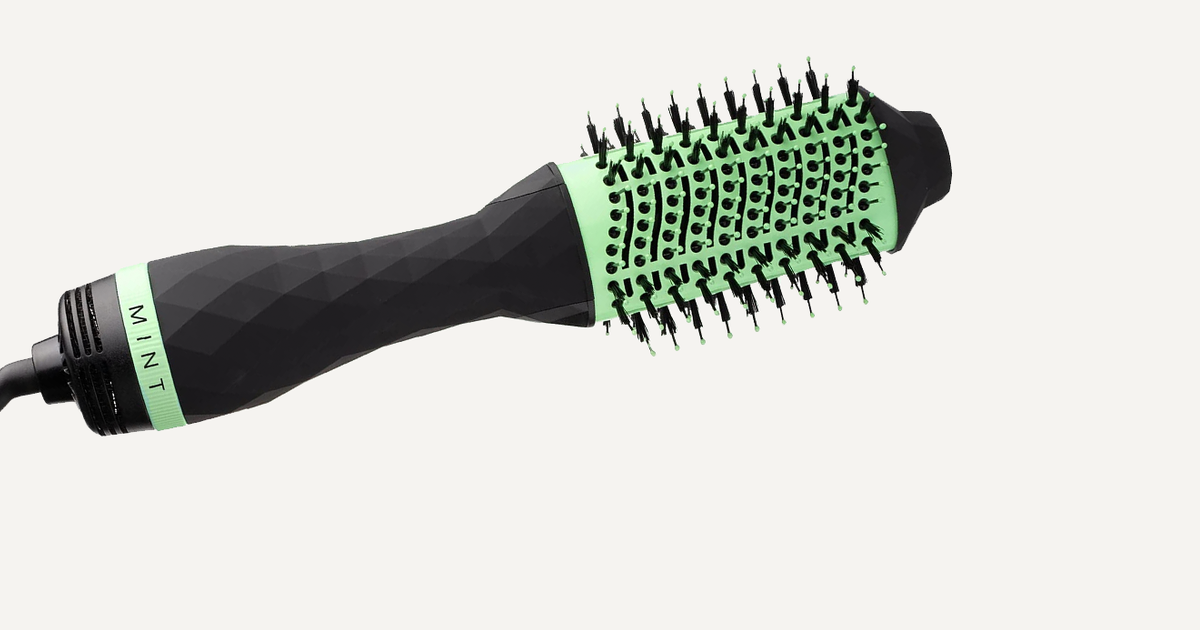
The second is MINT Professional Hair Tools, a separate Canadian manufacturer with no relationship to Revlon. MINT has made professional styling tools since at least 2016, founded by hairstylist Van Hong and engineer Kelly Wong, and supplies salons across Canada and the United States. Its blow dryer brush is the non-rotating alternative in this comparison: a 1.5-inch tourmaline ceramic oval barrel, 1,100 watts, three heat settings, mixed long ball-tip and short bristles, at $89.99. It sits between the drugstore models and salon two-piece systems on price, and its notably smaller barrel is the real point of difference — 1.5 inches against Revlon’s 2.4 or 2.8, which means more root lift and less pure smoothing.
Is the Revlon One-Step still the one to beat? On sales volume and price, yes, and it remains the sensible default for long hair that mainly needs smoothing. On barrel sizing for shorter or layered hair, the large oval is a genuine limitation, and smaller-barrel competitors answer it directly. What matters in the price gap — build, motor, warranty, duty cycle — is covered in this breakdown of what makes a blow dryer brush salon-grade.
The Five Brands Side by Side
Reduced to specifications, the field sorts itself quickly. The first column is the one most listings obscure: several of these are not one-step dryer brushes at all.
| Brand / model | Type | Barrel | Power | Rotates |
|---|---|---|---|---|
| Revlon One-Step Volumizer | One-step hot air brush | 2.8″ oval | 1,100W | No |
| Revlon One-Step Volumizer Plus 2.0 | One-step hot air brush | 2.4″ oval ceramic | Listings vary | No |
| Remington Shine Therapy | One-step hot air brush | 2.4″ oval ceramic | 1,100W | No |
| MINT Blow Dryer Brush | One-step hot air brush | 1.5″ oval tourmaline ceramic | 1,100W | No |
| Conair InfinitiPRO Spin Air | Rotating hot air styler | 2″ and 1.5″ heads | 500W | Yes |
| Mane hot round brush | Heated brush, no airflow | 4 sizes | Preset 355°F | No |
| Paul Mitchell Express Ion Round | Passive brush, no motor | Multiple sizes | None | No |
| National (retired brand) | Legacy / Panasonic successor | Varies | 100V domestic | Varies |
Four of the eight entries are not what a “blow dryer with spinning brush” search is looking for, and exactly one of them rotates.
Who Each Type Is Actually For
Buy a rotating styler if reaching behind your head is the hard part — limited shoulder mobility, an injury, or simply never having learned the wrist motion. Accept slower drying as the cost, and choose a model whose spin can be switched off.
Buy a non-rotating one-step brush if you want the fastest path from damp to finished and you can manage a basic brush turn. This is the right answer for most buyers, and it is where nearly all the engineering investment in the category has gone.
Buy a heated round brush if your hair is already dry and you want to reshape it — a second-day tool rather than a post-shower tool.
Buy a passive round brush and a separate dryer if you have the technique or a stylist does. It remains the highest-ceiling method, and it is the only one that scales to professional work.
The mismatch between those four and the single search phrase people use is the reason this category generates so many disappointed reviews. The tool usually works; it was just never the tool the buyer had in mind.
Frequently Asked Questions
Are spinning blow dryer brushes actually better than the ones that don’t rotate?
Spinning blow dryer brushes are easier to control but less powerful, so neither type is better in general. Rotation handles the wrist movement for you, which helps if reaching behind your head is difficult. The tradeoff is wattage: rotating models like the Conair Spin Air run around 500 watts against 1,100 for common non-rotating brushes, so they dry more slowly.
Do rotating blow dryer brushes tangle or pull your hair?
Rotating blow dryer brushes can tangle or pull hair more than static ones, because the barrel keeps turning whether or not the hair is feeding onto it smoothly. Flexible bristles and a spin-off mode reduce it but do not remove it. Working in smaller sections and detangling fully before styling is the practical fix.
Revlon vs. Mane vs. Paul Mitchell blow dryer brush — which one is worth the money?
Only Revlon makes a true one-step blow dryer brush among those three. Mane sells a heated round brush with no airflow, used on dry hair, and Paul Mitchell sells a passive vented round brush paired with a separate dryer. If you want one tool that dries and styles together, Revlon is the comparison — alongside Remington and MINT, which make directly competing one-step brushes.
Which spinning blow dryer brush works best on thick or coarse hair?
Thick or coarse hair is generally better served by a high-wattage non-rotating brush than by a spinning one. Rotating models divert power to the drive motor, typically landing near 500 watts, which is not much airflow for a dense head of hair. If you want rotation anyway, choose a model with interchangeable heads and use the larger barrel with generous sectioning.
Is the Revlon One-Step still the one to beat, or has something better come out?
The Revlon One-Step is still the volume leader and remains the sensible default for long hair that mainly needs smoothing. Its 2.4- to 2.8-inch oval barrel is the main limitation, since large barrels favor straightening over lift and struggle on shorter or layered hair. Competing 1.5-inch brushes from brands including MINT and Remington address that specific gap.
Comparative product reporting. Specifications are as published by each manufacturer at time of writing and vary by model and retailer; no brand in this comparison sponsored or reviewed it before publication.
Read us often? Make Business News Life a preferred source in Google Search and see our reporting more often in Top Stories.