How a Family-Owned Painting Company Uses Custom AI Tools to Run Its Office
A family-owned residential painting company in Southern California runs its sales process on seven custom tools, most of them built around AI, that handle lead follow-up, estimate booking, proposals and color approvals. Rob Pene, founder of Mission Driven Brand in Torrance, California, and his team built the system around software the company already used. For owners asking how small businesses use AI, the case is a practical one: each tool does one job at one step of the sale.
Key takeaways
- The painting company uses seven custom tools that cover a job from first contact to signed colors, plus one tool for hiring estimators.
- Each tool targets a specific leak, such as leads that never got a second follow-up or proposals that took hours to write.
- The tools connect to the company’s existing project board, Google Calendar and email, so the team did not have to switch software.
- The system covers the sales side only. Crew scheduling and invoicing still run on the company’s existing tools.
What are custom AI tools for small business?
Custom AI tools are small, purpose-built programs that take over one repeatable task in a business, usually a task that eats office time or lets revenue slip. They differ from an all-in-one software package because they are shaped around how a particular team already works.
Mission Driven Brand describes its approach as finding the step in a business that loses leads or time, then building the smallest tool that fixes it. AI shows up in specific places: reading a screenshot of a Yelp message, turning a spoken walkthrough into a written proposal, summarizing a job candidate’s test answers. Everywhere else, the tools are simple lists, forms, calendars and emails.
What problem was the painting company trying to solve?
The company was already good at the work. The trouble was everything around it. Leads came in by phone, Yelp, Facebook, email and the website, and some never got a second follow-up. Estimates were booked by text, and estimators zigzagged across the county in a single day. Proposals were written late at night, color choices were approved on a printed sheet, and the owner could not see sales numbers in one place.
None of that required expensive enterprise software. The case study frames it as a set of small leaks, each one fixable on its own. For a company where the average job runs about $13,000, a single lead that never gets a second call is not a rounding error.
How does a job move through the tools, step by step?
The system follows the order of a real job. A lead arrives, an estimate gets booked, a proposal goes out, the homeowner compares bids, colors get approved, and the owner reviews the numbers. A seventh tool sits outside the job flow and supports hiring.
| Step | Tool | Problem it solves |
|---|---|---|
| 1. Lead comes in | Lead tracker | Leads from five channels got lost, and some never received a second follow-up. |
| 2. Estimate booked | Self-booking estimate calendar | Booking by phone and text took back-and-forth, and estimators drove all over the county. |
| 3. Proposal written | AI proposal builder | Detailed proposals took hours, so they went out late or thin. |
| 4. Homeowner compares bids | Homeowner bid comparison guide | Homeowners compared bids on price alone, which made thorough proposals look expensive. |
| 5. Colors approved | Paperless color sign-off | Paper color sheets got lost, delayed jobs and caused do-overs. |
| 6. Owner sees the numbers | Revenue dashboard | Estimates, proposals, accepted jobs and ad spend lived in separate places. |
| 7. Hiring | Sales estimator assessment | Interviews did not show which candidates could actually close. |
How do these tools handle the routine office work?
Most of the value comes from tasks that used to depend on someone remembering to do them.
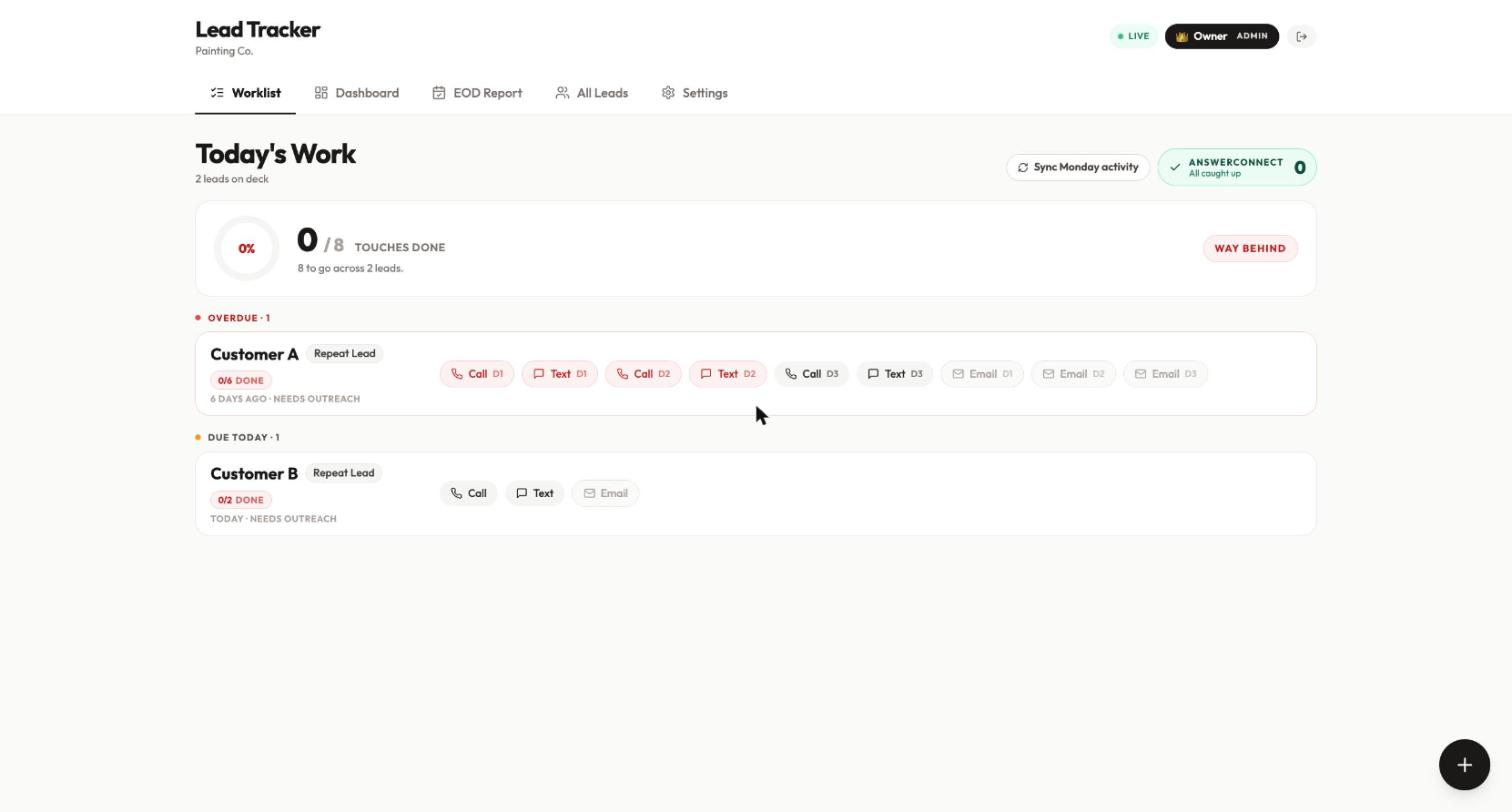
The lead tracker gives every lead a three-day follow-up plan, with a call, a text and an email each day. New leads arrive automatically, through bulk import, or from a screenshot that AI reads, and duplicates within 24 hours are merged so nobody calls the same person twice. When an estimate is booked in the project board, the tracker marks the lead as converted and credits the estimator. Every night the team gets an end-of-day email showing leads in, follow-ups done and missed, estimates booked, and a scorecard for each person.
The booking calendar lets homeowners choose their area first, then shows only open times for that area. Once a day gets its first booking, that day locks to the area, which keeps an estimator’s appointments close together. The owner controls workdays, hours, blocked days and how far ahead people can book.
The proposal builder starts from a voice memo, typed notes or photos taken after a walkthrough. AI fills in scope, prep steps, colors and sheens, exclusions, warranty, schedule, price and deposit, and suggests add-ons. The estimator still edits, previews and prices the result before saving it. The color sign-off works the same way: the office enters up to five colors, the customer gets a private link, and both sides receive a confirmation the moment it is signed. An AI preview can also repaint a photo of the customer’s own house in the chosen color.
The case study does not claim that these tools let the company skip hiring, and it gives no hours saved. What it describes is work that now has a system behind it: a scheduled follow-up instead of a sticky note, a draft proposal instead of a blank page, a signed approval instead of a lost sheet.
What did the numbers show?
The same company appears in an earlier Mission Driven Brand ads case study. From January through August 2026, its paid ads cost $65,309 and produced about $270,277 in signed jobs, a return of 4.1 times. The ads brought in the leads. The tools are meant to make sure each of those leads is followed up, booked, quoted and approved.
Seeing the numbers in one place also exposed a tracking problem. Thirty-nine customers had been mislabeled as coming from “Google” in the company’s CRM until the tracking was fixed. For an owner deciding where to spend the next ad dollar, mislabeled sources can quietly point spending in the wrong direction. The revenue dashboard shows close rate, average job size, pace toward the annual goal and return on ad spend by channel, so errors like that are easier to catch.
There was also a sign of how customers now find local contractors. A homeowner booked an estimate and noted that they “found us on ChatGPT.” One booking is an anecdote, not a trend, but it shows that AI search can already send a homeowner to a local contractor.
What does the system leave out?
The system stops where the sale ends. Crew scheduling and invoicing still run on the company’s existing tools, and the case study says that is on purpose. The builders started where leads and revenue were leaking, not where the software would be most interesting.
Client names and data stay private. Mission Driven Brand publishes tool screenshots with names anonymized and withholds the revenue dashboard screenshot because it shows the client’s private revenue.
What can other contractors and small businesses take from it?
The lessons travel well beyond painting. First, start with the leak, not the technology. Ask where leads go quiet, where staff retype the same information, and where a customer waits on you. Second, keep each tool narrow. One tool with one job is easier to build, easier for a team to adopt and easier to judge. Third, connect new tools to what you already use. Calendar, email and project board integrations meant nobody had to learn a new system.
Mission Driven Brand says tools like these take days or weeks to build, not months, because each one does a single job. Owners who want to see the screenshots and the exact steps can read the full case study and screenshots.
Frequently asked questions
What counts as a custom AI tool for a small business?
It is a purpose-built tool that handles one task, such as tracking leads, drafting proposals or collecting approvals. AI is used where it helps, for example reading a screenshot or summarizing notes, while the rest is ordinary software tailored to the team’s workflow.
Do these tools replace the software a contractor already uses?
No. In this case study, the tools connect to the company’s existing project board, Google Calendar and email. Crew scheduling and invoicing stayed on the company’s current tools.
Does the AI make the final decisions?
No. The estimator edits, previews and prices every AI-drafted proposal before saving it. For hiring, AI writes a short summary of each candidate’s strengths and gaps, and the owner can see every answer in an admin view.
How long does it take to build tools like these?
Mission Driven Brand says each tool takes days or weeks, not months, because it is built to do one job and plugs into software the business already runs. Timelines for any given business depend on the problem being solved.
Source note: Details come from Mission Driven Brand’s published case study. Mission Driven Brand is affiliated with this publication.
Read us often? Make Business News Life a preferred source in Google Search and see our reporting more often in Top Stories.