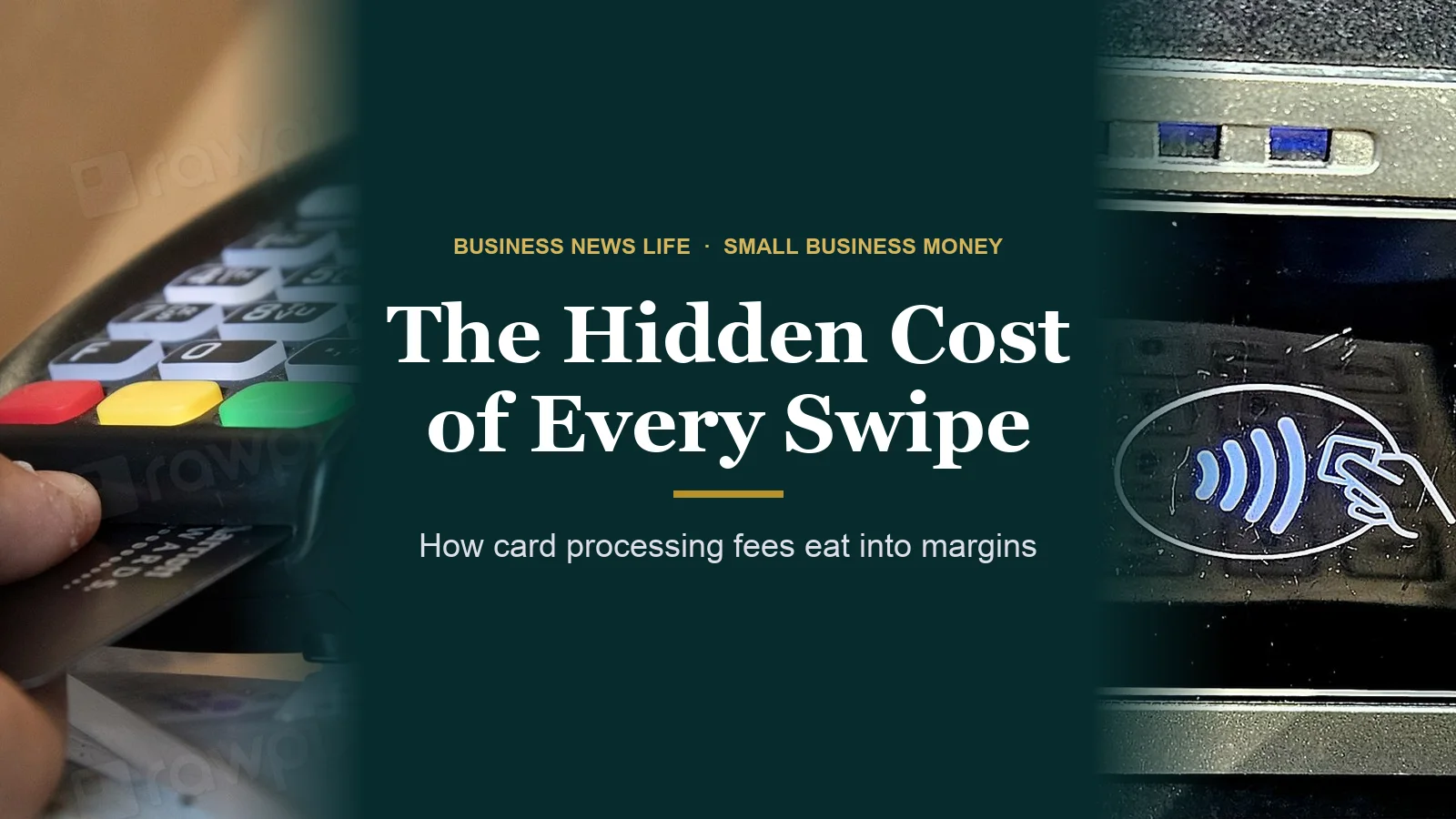
The Hidden Cost Eating Your Margins: How Card Processing Fees Add Up
Picture a coffee shop owner at a corner table after closing, the chairs stacked and the espresso machine ticking as it cools. The monthly processing statement is spread out next to a calculator, four pages long.
Sales were up. The deposit was not up nearly as much. Somewhere between the card reader and the bank account, money went missing, and the statement does not make it easy to see where.
That gap is card processing fees, and for many small businesses it is one of the largest costs they never really examine. Here is how those fees are built, and how to read the statement that hides them.
Quick answer
Credit card processing fees combine three layers: interchange paid to the card-issuing bank, network fees charged by Visa or Mastercard, and your processor's markup. Interchange varies by card type and how the card is accepted. To compare costs, divide total monthly fees by total card volume to get your effective rate.
Key takeaways
- Every card fee combines interchange, network fees and the processor's markup.
- Visa's published interchange runs from about 0.05% plus 21 cents to over 3%.
- Federal rules cap debit fees for large banks; credit cards have no federal cap.
- Your effective rate, total fees divided by card volume, is the fairest comparison.
- The processor's markup is usually the part you can negotiate.
Why do card processing fees feel so hard to understand?
Because one line on your statement is really three or four different charges, set by different players, stacked together. Your processor bundles them, and the bundle often hides which part is fixed and which part is negotiable.
Card payments are also a bigger share of sales than ever. Federal Reserve diary data analyzed by Pew Research Center shows credit cards accounted for 34% of U.S. consumer payments in 2025, up from 18% in 2015. Cash fell from 33% to 14% over the same decade. Fewer cash sales means more of every day’s revenue passes through the card fee machine.
What are the parts of a credit card processing fee?
Almost every card transaction carries three layers of cost.
1. Interchange
Interchange is the largest piece for most merchants. It is paid to the bank that issued your customer’s card. Visa says plainly that “merchants do not pay interchange reimbursement fees” directly; instead, merchants pay a “merchant discount” to their own financial institution, which covers interchange and other services, according to Visa’s regulation and fees page.
The rates are published. Visa’s U.S. interchange schedule, effective April 18, 2026, runs to 28 pages because the fee changes with the card type, how it was accepted and the kind of business. Rewards cards cost more. Keyed-in cards cost more than tapped or dipped ones. Some categories, like restaurants and travel, have their own rates.
2. Network fees, often called assessments
Visa and Mastercard also charge their own fees for running the network. These usually appear as small percentage and per-item charges, sometimes broken into many line items with names that only a payments specialist would recognize. Your processor passes them through.
3. The processor’s markup
This is what your processor, or the bank and reseller behind it, keeps. It can be a percentage, a per-transaction fee, monthly fees, or all of the above. Unlike interchange, this is the layer you can usually shop and negotiate.

How much does interchange cost on a typical sale?
Here is how the published Visa card-present rates play out on a $50 in-store sale. The percentages come from Visa’s April 2026 schedule; the dollar amounts are our arithmetic.
| Card used on a $50 sale | Visa interchange rate | Interchange cost |
|---|---|---|
| Debit card from a large bank (regulated) | 0.05% + $0.21, plus $0.01 fraud adjustment | About $0.25 |
| Debit card from a smaller bank (exempt), retail | 0.80% + $0.15 | $0.55 |
| Traditional rewards credit card, retail | 1.43% to 1.51% + $0.10 | About $0.82 to $0.86 |
| Visa Infinite card, spend qualified, retail | 2.30% + $0.10 | $1.25 |
| Non-qualified consumer credit | 3.15% + $0.10 | About $1.68 |
The same $50 sale can cost you a quarter or well over a dollar in interchange alone, depending on which card the customer pulls out. You have no control over that choice, which is why your effective rate drifts from month to month.
Online and phone orders usually cost more. In the same schedule, a traditional rewards card on a standard card-not-present sale carries 2.04% + $0.10, compared with 1.43% to 1.51% + $0.10 in person. For debit cards from smaller banks, the card-not-present rate is 1.65% + $0.15, about double the in-store 0.80% + $0.15. If more of your holiday sales move to your website or the phone, expect your effective rate to climb with them.
Why are debit cards cheaper to accept?
Federal rules cap them. Under the Federal Reserve’s Regulation II, debit issuers with $10 billion or more in assets can charge no more than 21 cents plus 0.05% of the sale, plus a 1-cent fraud-prevention adjustment for issuers that qualify. The Fed described that standard, and a proposal to lower it, in a November 2023 Federal Register notice. Check the Fed’s Regulation II pages for the current status before you build plans around a change.
Debit cards from smaller banks and credit unions are exempt from the cap, which is why Visa lists separate “exempt” and “regulated” debit rates. Credit cards have no federal cap at all.
Paying too much to take cards?
Qualifying merchants who switch payment processors can get a free $10,000 growth package, including a website, Google Business Profile, landing pages, content and tracking, through our partner Fees to Growth. (Partner offer)
Which pricing model is best: flat rate, tiered or interchange-plus?
Processors package those three layers in a few common ways. None is right for every business.
- Flat rate. One percentage plus a fixed fee on every card, no matter the type. Stripe’s standard U.S. pricing, for example, is 2.9% + 30 cents for online domestic cards and 2.7% + 5 cents for in-person payments on its Terminal readers. Flat rates are simple to forecast. On a lot of low-cost debit transactions, though, you may pay well above the underlying interchange.
- Tiered. The processor sorts transactions into buckets such as “qualified,” “mid-qualified” and “non-qualified,” each with its own rate. The processor decides what lands in each bucket, which makes it hard to compare offers.
- Interchange-plus. You pay the actual interchange and network fees, plus a disclosed markup. Stripe lists interchange-plus as a custom option for businesses with large payment volume. This model makes the markup visible, so it is the easiest one to compare across processors.
- Subscription or membership. You pay interchange and network fees at cost plus a flat monthly fee instead of a percentage markup. It can suit steady, higher-volume shops.
A rough rule: the more you sell and the more of it is debit, the more an interchange-plus or subscription model tends to help. Low-volume sellers often value the simplicity of flat rates. Run your own numbers before switching.
How do you read a merchant processing statement?
Pull your last three statements and work through them with a pen. Five steps cover most of it.
- Find total card volume. This is the dollar amount of card sales processed in the month.
- Find total fees. Add every fee line, including monthly, PCI, statement, batch and equipment charges. Some statements bury these on the last page.
- Calculate your effective rate. Divide total fees by total volume. If you processed $40,000 and paid $1,240 in fees, your effective rate is 3.1%. This single number is the fairest way to compare one month, or one processor, to another.
- Separate pass-through costs from markup. On an interchange-plus statement, interchange and network fees are listed apart from the processor’s own charges. On flat or tiered pricing, ask your processor in writing for a breakdown.
- Look for creep. Compare statements a year apart. New line items, rising monthly fees and “non-qualified” surcharges are common places where costs grow quietly.
Fees are a real expense, but they are easy to miss when deposits look healthy. Our explainer on why your bank balance can mislead you about profit shows how costs like these quietly shrink what you keep.

Can a small business lower its card processing costs?
Often, yes, though savings depend on your mix of cards and how you accept them. Practical moves include:
- Tap or dip instead of keying in. Visa’s schedule charges more for key-entered transactions. Keep card readers working and train staff to avoid typing card numbers when a card is present.
- Ask for interchange-plus quotes. Get at least two written offers that spell out the markup, monthly fees, contract length and early termination fees.
- Cut unneeded fees. Duplicate gateways, unused terminals and add-on services can often be dropped with a phone call.
- Price with fees in mind. If processing runs near 3% of sales, it belongs in your pricing math. Our guide to price-pack architecture shows ways to protect margin without a blunt price hike.
- Know the surcharge rules before you add one. Visa says merchants must notify their acquirer 30 days before they begin surcharging, and state laws vary. Talk to your processor and an attorney or accountant first.
Change may also come from outside. In June, a federal judge gave preliminary approval to a revised settlement between merchants and Visa and Mastercard, PYMNTS reported. As described, it would cut interchange by 0.1 percentage point for five years and cap standard consumer card rates at 1.25%. Preliminary approval is not final, and the timing of any change is uncertain, so do not count those savings yet.
When is the best time to review processing fees?
Before your busiest stretch. For most retailers and restaurants that means now, ahead of November and December, when card volume peaks and a few tenths of a percent adds up fastest. If you are still building your holiday plan, our list of Q4 moves small businesses should make pairs well with a fee review.
Back at that coffee shop, the owner’s late-night math is a lot clearer with an effective rate written at the top of the page and every fee sorted into interchange, network fees and markup. The first two may not budge. The third is a conversation, and it is worth having before the holiday rush pushes even more sales through the reader.
Get your story in Business News Life
Did a closer look at your processing statement change how you run your shop? Business News Life wants to hear from owners who found the leaks and fixed them, so other Main Street businesses can learn from it.
Frequently asked questions
What is a normal credit card processing fee for a small business?
There is no single normal rate, because costs depend on your card mix, how cards are accepted and your pricing model. Published flat rates such as Stripe's 2.7% plus 5 cents in person and 2.9% plus 30 cents online give a useful reference point. Calculate your own effective rate by dividing total fees by total card volume.
Who sets interchange fees?
Card networks such as Visa and Mastercard publish interchange schedules, and the fees are paid to the bank that issued the customer's card. For debit cards from banks with $10 billion or more in assets, the Federal Reserve's Regulation II caps the fee.
Can a business pass credit card fees on to customers?
In many cases merchants can add a surcharge on credit cards, but card network rules and state laws set limits. Visa requires merchants to notify their acquirer 30 days before they begin surcharging. Check with your processor and a legal or tax professional before adding one.
Is interchange-plus pricing always cheaper than flat rate?
Not always. Interchange-plus shows the true cost and markup, which often helps higher-volume businesses and those with many debit transactions. Very small sellers may find flat-rate pricing simpler and roughly comparable once monthly fees are included.
Why do rewards credit cards cost merchants more?
Issuers fund rewards partly through higher interchange. In Visa's April 2026 schedule, a spend-qualified Visa Infinite card at retail carries 2.30% plus 10 cents, compared with 1.43% to 1.51% plus 10 cents for a traditional card.
Sources
- Visa: Visa USA Interchange Reimbursement Fees (April 18, 2026)
- Visa: Regulation and fees for businesses
- Federal Register: Debit Card Interchange Fees and Routing proposed rule (Nov. 14, 2023)
- Pew Research Center: From cash to credit, how Americans' payment methods have changed
- Stripe: Pricing
- PYMNTS: Judge Signals Approval for Visa and Mastercard Swipe Fee Settlement